
Sell your Tesla Model S directly to us for a real, no-obligation offer, usually in under 15 minutes. We use EV transaction data and inspect the battery, drive unit, mileage, configuration, and software-enabled features, so your offer reflects the specific Model S you own.
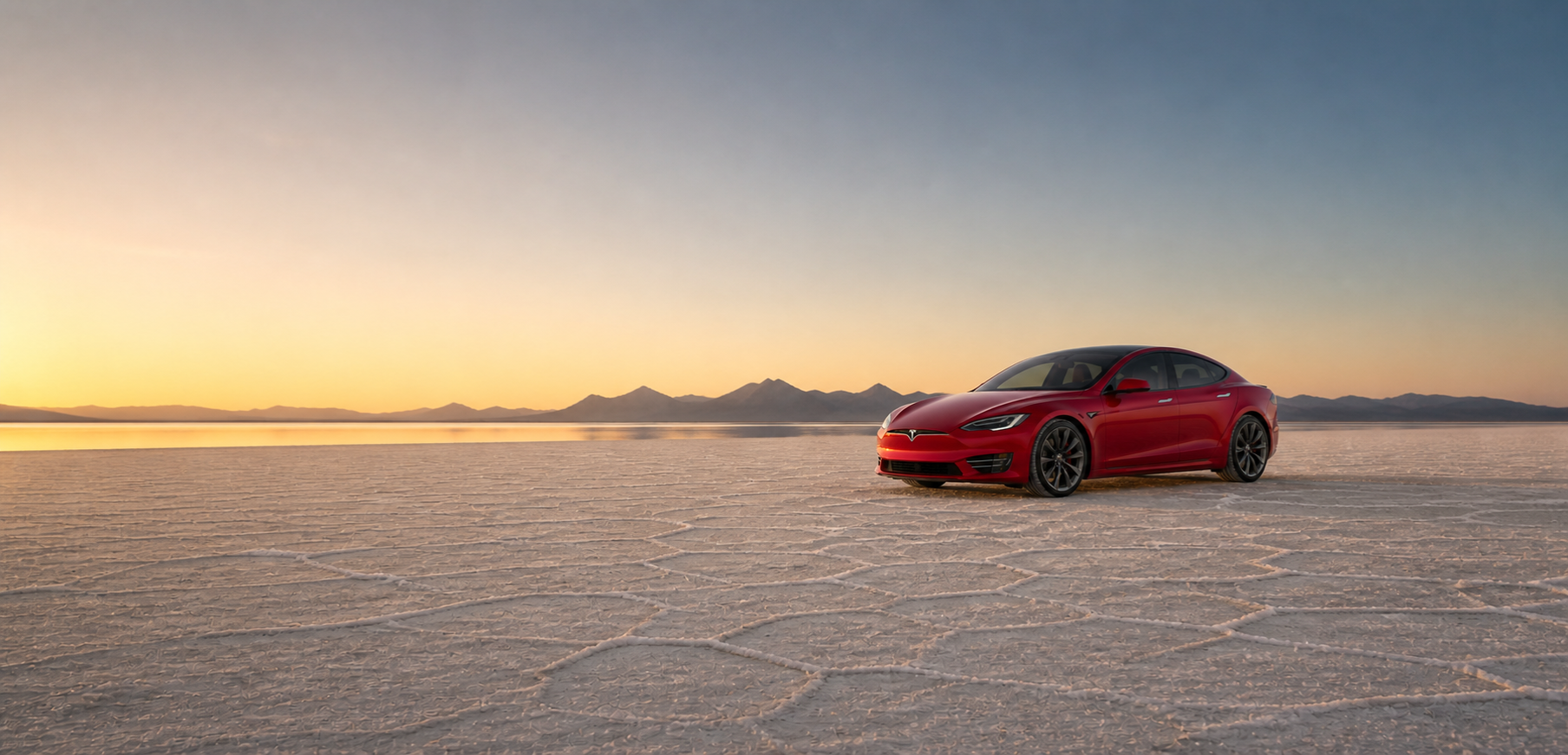
The Tesla Model S is a battery-electric luxury liftback sold in the United States for model years 2013 through 2026. Tesla ended Model S production after the 2026 model year.
That long production run is why a Model S should not be treated as one uniform used EV. A 2013 car with an early battery pack, a dual-motor 2016 car, a 2020 Long Range, and a 2026 Plaid share the same badge, but they bring different range figures, hardware, drivetrain layouts, and buyer questions. The practical next step is to identify your exact year, trim, wheel setup, and active features before asking for an offer.
The earliest cars were sold as 40, 60, 85, and Performance variants. Tesla expanded the line through 70, 75, 85D, 90D, 100D, P85D, P90D, and P100D configurations before moving toward Long Range, Performance, and Plaid naming. The current-generation naming is simpler, but the underlying details still matter. A buyer considering your Model S will want to know whether it is a rear-wheel-drive early car or a dual-motor or tri-motor configuration, which battery family it has, and whether the vehicle has the equipment and software they expect.
Range is usually the first question because it quickly places a Model S in its generation. The launch-era 2013 lineup ranged from 139 EPA miles for the 40 kWh version to 265 EPA miles for the 85 kWh version. By 2020, the Long Range was rated at 402 EPA miles. The 2021 refresh brought a 405-mile Long Range and a 348-mile Plaid on 19-inch wheels. Later cars can have very different ratings even when their battery capacity looks similar, because drivetrain, wheels, and calibration all affect the published figure.
A knowledgeable buyer will also look beyond the dashboard range display. The battery's state of health, charging behavior, drive-unit operation, warning messages, suspension behavior, body condition, tires, and service history all help describe the car that exists today. For an older Model S, this is more useful than treating mileage as a shortcut for every aspect of condition. For a newer car, it helps separate two otherwise similar listings with different hardware and enabled capability.
We buy your Model S directly, nationwide. Tell us the vehicle details, receive a real offer usually in under 15 minutes, and take time to decide. The offer is based on EV transaction data and the specific condition and configuration you report, rather than a generic VIN-decoder estimate.
The Model S changed more often than its exterior shape suggests. Knowing the trim name on your registration is useful, but it is only the start. Battery size, drive motors, range rating, display hardware, wheel size, and enabled driver-assistance capability can all distinguish one Model S from another.
The early lineup is defined by pack badges. The 2013 Model S came in 40, 60, 85, and Performance forms, with published 40 kWh, 60 kWh, and 85 kWh battery packs. Tesla's launch specifications set out that original structure. In 2014, the lineup used 60, 85, and Performance names. In 2015, 70, 85, 85D, and P85D appeared. The 2016 range included 70, 70D, 75, 75D, 90D, and P90D.
From 2017 through 2019, the configuration list grew around 75 kWh and 100 kWh models:
Tesla's owner-manual material identifies Model S battery capacities spanning 60, 70, 75, 85, 90, and 100 kWh. For 2017 through 2026 cars, the long-range battery family is documented as a 100 kWh gross pack. Some specifications list about 96 kWh usable capacity, so it is worth reporting the exact trim and not assuming that every 100 kWh car has identical usable energy or range.
The 2020 Model S was sold as Long Range and Performance, while 2021 and 2022 used Long Range and Plaid. The 2023 through 2026 range uses Model S and Model S Plaid. For the 2024 Model S, the standard model was rated at up to 402 miles of EPA range. For 2026, the Model S has 410 miles of EPA range and the Model S Plaid has 368 miles on 19-inch wheels. The Plaid's 21-inch wheels reduce its EPA figure to 309 miles, which is why wheel choice belongs in an accurate configuration description.
Software and hardware deserve the same attention. Full Self-Driving capability, Autopilot hardware generation, active subscriptions, and over-the-air update status can change what a Model S offers a future buyer. They also affect how a buyer interprets the car's history. Several Model S recalls were resolved through over-the-air updates, while some concerns required physical service. If you have a service invoice, recall-completion record, or screen photos showing enabled capability, keep them ready for the self-inspection.
Warranty coverage is useful ownership background, not an offer input. Earlier Model S battery and drivetrain coverage was described as eight years with unlimited miles. The 2026 model has four years or 50,000 miles of basic coverage and eight years or 150,000 miles of battery and drivetrain coverage. Battery and drivetrain coverage transfers to a subsequent owner under the coverage terms. That means an early Model S is generally well beyond its original battery and drive-unit coverage period, while a recent Model S can still have years of coverage remaining, subject to its in-service date and mileage.
Those differences are why a generic used-car formula is a poor fit. Your Model S has a specific battery family, drive-unit setup, condition profile, and equipment list. We look at those EV details directly when evaluating it.

Owners sell for reasons specific to this vehicle and to where they are in ownership:
Your lease is ending, and you want a direct sale without arranging several appraisals.
You are moving to a different EV, such as a Tesla Model 3 or Tesla Model Y.
Your transportation needs have changed, and the Model S no longer fits your routine.
A second vehicle is sitting unused, and you would rather turn it into funds.
You are moving, downsizing, or simplifying the number of vehicles in your household.
You want to sell before spending time documenting battery condition, recall history, and enabled features for private buyers.
If any of that describes your situation, the next section is the answer.

If you are selling a Model S, the hard part is often not deciding to sell. It is explaining exactly what you have, then comparing offers that may not be measuring the same vehicle. The nameplate spans early rear-wheel-drive cars, dual-motor versions, high-capacity battery cars, Long Range versions, and Plaid models. A quick appraisal that does not ask about battery condition, drive-unit operation, wheel setup, or paid capability can leave out the details that make your car distinct.
A private sale can work if you want to create the listing, arrange charging for test drives, answer range questions, and walk each interested buyer through service and recall records. An open recall can be checked by VIN at NHTSA, but gathering that information and explaining its status is work you no longer need to do yourself. The same applies to explaining whether Full Self-Driving capability is enabled, whether a feature is subscription-based, or whether a service bulletin was completed.
A dealer trade-in has a different constraint. Without an EV buyer network, a vehicle can be priced as a wholesale unit intended to move quickly. Some stores are also cautious about holding EV inventory. That does not make a trade-in wrong, but it can mean the appraisal uses broad used-car methods rather than a close review of the Model S battery, drive unit, and software-enabled configuration.
We buy your Model S ourselves. We start with the exact vehicle, including its year, trim, drivetrain, mileage, battery condition, drive-unit condition, and software-enabled features. Our offer comes from real transaction data on EVs we have actually bought and sold. We lead with our best number, so there is no negotiation or back-and-forth built into the process.
Most sellers receive an offer in under 15 minutes. It is free and carries no obligation. If you accept, one EV buying expert supports you from offer through pickup. You complete a guided smartphone self-inspection on your own time, and the offer holds for seven days unless something material differs from what you reported. There are no paperwork, transport, closing, or processing fees, and nothing is deducted at pickup.
We arrange free pickup from your driveway anywhere in the United States and handle title-transfer and DMV paperwork as part of the sale. If your Model S is financed, we pay your lender directly. If it is leased, we coordinate payoff with the leasing company, which typically takes two to three weeks after you sign the buyout authorization. Once we receive the title, payment is sent by wire or ACH, typically within 24 to 48 hours, with funds reaching you at or before pickup.
Start with your Model S details to get a real offer and decide on your own timetable.
We confirm your Model S model year, trim, drivetrain, battery family, wheel setup, mileage, and configuration. Long Range, Performance, Plaid, early pack badges, and drive-motor layouts describe different vehicles.
We review overall condition, then focus on battery state of health and drive-unit condition. Report warning messages, charging concerns, vibration, prior repairs, cosmetic damage, and anything affecting normal operation.
We check software-enabled capability that stays with the vehicle, including Full Self-Driving or Autopilot configuration, relevant hardware generation, subscriptions, and available over-the-air update status.
We compare your exact Model S configuration, options, condition, and location with real EV transactions, not a national average or a generic gas-car mileage formula.
We give you our best number with no negotiation or back-and-forth. Your no-obligation offer holds for seven days and changes only if the guided self-inspection finds a material difference from what you reported.
“My offer was much more than Tesla, Carvana, and Carmax. Didn't have to take my car anywhere.”
“I was a little nervous selling my car online, but Anita gave me the assurance I needed the whole way.”
“The process was really easy and smooth. No last-minute tricks like you get at dealerships.”
“We were skeptical at first, but checked Reddit and Google to make sure these guys are legit.”
After we receive the title, we send payment by wire or ACH, typically within 24 to 48 hours. Funds reach you at or before pickup, and there are no fees deducted from your accepted offer.
Yes. For a financed Model S, we pay your lender directly. For a leased Model S, we coordinate the payoff with the leasing company, which typically takes two to three weeks after you sign the buyout authorization.
Check your VIN at NHTSA for open recalls. Model S campaigns have covered items including seat belts, airbags, front-trunk latches, steering assistance, center-display memory, and driver-assistance software, with several remedies delivered over the air.
Software-enabled features can affect a Model S offer when they transfer with the vehicle or reflect its hardware generation. Tell us whether Full Self-Driving capability, Autopilot equipment, or subscriptions are active so we can evaluate the specific car accurately.
We need your Model S model year, trim, drivetrain, mileage, overall condition, battery condition, drive-unit condition, and software-enabled features. Photos and a guided smartphone self-inspection help confirm the details.
You can sell your Tesla Model S directly to us nationwide. We provide a real, no-obligation offer usually in under 15 minutes, then arrange free pickup if you accept.