
Sell your Kia EV9 directly to us for a real, no-obligation offer, usually in under 15 minutes. We use EV transaction data and your EV9's battery condition, drive unit, software-enabled features, and mileage, with no fees deducted from the offer you accept.
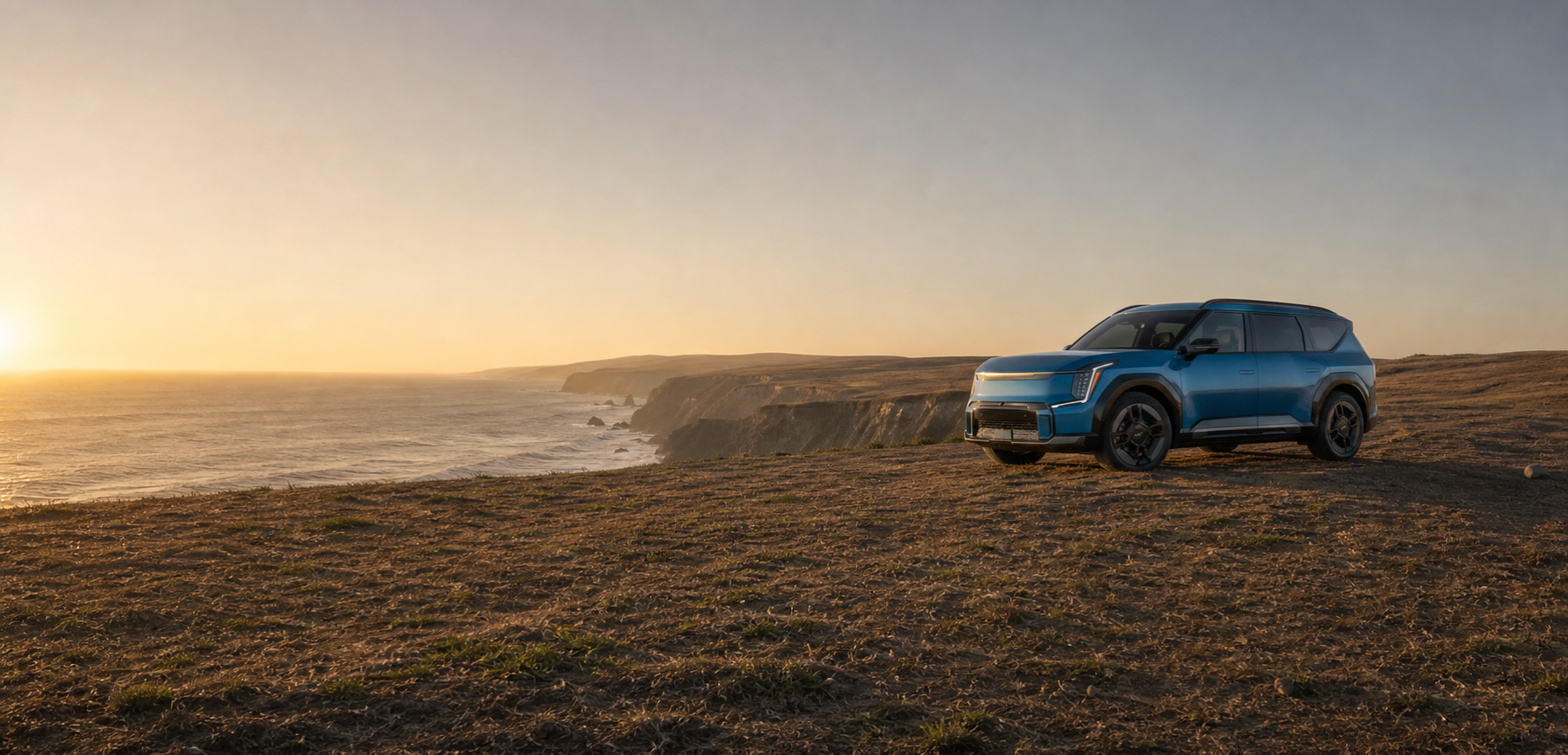
The Kia EV9 is a battery-electric, three-row SUV built on Hyundai Motor Group's E-GMP electric vehicle platform. It is sold in the United States for model years 2024 through 2026, with rear-wheel-drive and dual-motor all-wheel-drive configurations.
If you are considering selling yours, start with the details that make one EV9 meaningfully different from another. The trim badge, battery pack, drivetrain, seating configuration, mileage, battery condition, and completed campaigns all give a buyer a clearer picture than a generic SUV appraisal can.
The EV9 is a large electric SUV, and that affects the practical questions a buyer tends to ask. They will want to know whether yours is the standard-range Light or a 99.8 kWh long-range version. They will ask whether it is rear-wheel drive or AWD, whether the three rows have been used heavily, and whether charging and display updates are current. A clear answer to those questions helps the vehicle be assessed as the EV it is.
Range is configuration-specific. The Light RWD is rated at 230 miles, while the Light Long Range RWD is rated at 304 miles. Wind and Land AWD are rated at 280 miles, and GT-Line AWD at 270 miles. Those differences are useful context for a buyer comparing two otherwise similar EV9s.
Before seeking an offer, have the basics ready:
You do not need to build a listing, arrange test drives, or explain every EV detail repeatedly to prospective shoppers. Give us your vehicle details, and we will assess your EV9 directly using the factors that matter for an electric vehicle.
The EV9 lineup uses two battery sizes across five core trims. Knowing your exact trim matters because the Light, Light Long Range, Wind, Land, and GT-Line have different battery, drivetrain, and range specifications. The 2026 Land AWD can also have the Nightfall Edition Package, which is a package on the Land AWD rather than a separate powertrain.
For 2024, 2025, and 2026, the Light is the standard-range RWD EV9. It uses the 76.1 kWh pack and has a 230-mile EPA rating. The Light Long Range is RWD with the 99.8 kWh pack and a 304-mile EPA rating. Wind e-AWD and Land e-AWD use the 99.8 kWh pack with 280 miles of EPA range. GT-Line e-AWD also uses the 99.8 kWh pack and is rated at 270 miles.
That means a Light Long Range and a Land can share the same 99.8 kWh battery while offering different drivetrains, range ratings, and equipment. Likewise, a 2024 Light and a 2026 Light use the same basic standard-range battery arrangement, but their history, mileage, condition, and vehicle-specific equipment are individual to each vehicle.
The EV9 is also an over-the-air update capable vehicle. That matters when documenting its history because some display-related work can be completed remotely. For example, recall 24V757000 allowed a dealer or OTA update for certain 2024 and 2025 EV9 instrument-panel software, while recall 26V046000 also provides an OTA or dealer remedy for certain 2026 EV9s. Confirming completed campaigns gives the next buyer a clearer maintenance record.
For early 2024 EV9s, Kia also issued a service action for scheduled-charging logic. The SA577 bulletin applies to certain vehicles built from September 25, 2023 through April 1, 2024, and updates Vehicle Charging Management System logic. Certain 2026 EV9s have a separate seat slide motor noise service action, where the power seat remains functional but can make a buzzing noise during adjustment.
Kia's EV coverage is useful background for a buyer evaluating a used EV9. The EV system warranty covers the electric motor, high-voltage battery, electric power control unit, and onboard charger for 10 years or 100,000 miles. Kia also provides battery-capacity coverage if capacity falls below 70% of its original level during that same period. The basic limited warranty is 5 years or 60,000 miles.
That coverage is attached to the vehicle for its remaining term, so a 2024 EV9 generally has more of the original coverage period remaining than a 2026 EV9 has used. Coverage and remaining mileage should be confirmed against your vehicle's in-service date and records. It is background for the next owner, not a substitute for documenting the current battery and drive-unit condition.
For an EV9 with an open recall, especially 26V431000, address the safety instruction first. If your VIN is affected by that battery recall, park outside and away from structures, and limit charging to 80% until the repair is complete. You can check your VIN and campaign status through NHTSA's recall lookup.

Owners sell for reasons specific to this vehicle and to where they are in ownership:
Your lease is ending, and you want a clear sale path instead of another dealership visit.
You are moving to a vehicle that better fits your household, parking, or charging routine.
A second vehicle is sitting unused after a work, commute, or family change.
You want to sell before a move, without arranging private-party test drives for a large electric SUV.
You have changed from an RWD or AWD configuration to a vehicle with different range or space needs.
You want one buyer to account for your EV9's battery, drivetrain, and completed software work.
If any of that describes your situation, the next section is the answer.

Selling an EV9 privately can work, but it asks you to do more than set a price. You may need to coordinate test drives around charging, answer questions about range and battery condition, explain trim differences, and walk a buyer through recall or software-update history. With a three-row EV, you may also be accommodating shoppers who need time to inspect seating, cargo space, and charging equipment.
A dealer trade can be convenient, but an EV9 can be treated as inventory that needs to move quickly, particularly when the dealership is not using an EV-specific assessment. A large electric SUV is not well described by a gas-car mileage formula. Its battery condition, drive unit, configuration, and enabled features require their own evaluation.
We buy your EV9 directly from you, nationwide. Most sellers receive a real offer in under 15 minutes, built from transaction data on EVs we have actually bought and sold, not a VIN-decoder estimate. We lead with our best number, so there is no negotiation or back-and-forth built into the process.
Our assessment focuses on the EV-specific details of your vehicle:
Your offer holds for seven days. It changes only if the smartphone self-inspection identifies something material that does not match what you reported. The inspection takes roughly 15 minutes and happens on your time.
There are no fees, ever. We do not deduct paperwork, transport, processing, or closing charges from your payment. The offer you accept is the amount you take home.
An EV buying expert stays with you from offer through pickup. We arrange free pickup from your driveway anywhere in the United States, handle title transfer and DMV paperwork, and send payment by wire or ACH after title receipt. Funds reach you at or before pickup, typically 24 to 48 hours after we receive the title.
If you have a loan, we pay your lender directly. If you are leasing your EV9, we coordinate payoff with the leasing company, which typically takes two to three weeks, and you sign the buyout authorization. An offer carries no obligation, and you can decline it at no cost. Start with your EV9 details to get a straightforward offer.
We confirm whether your EV9 is a 2024, 2025, or 2026 Light, Light Long Range, Wind, Land, or GT-Line. We also verify RWD or AWD, battery configuration, mileage, and relevant options such as the Land AWD Nightfall Edition Package.
We assess overall condition, then focus on battery state of health and drive unit condition. Let us know about charging behavior, 12-volt concerns, display issues, damage, and completed recall or service work.
We confirm relevant software-enabled capabilities and update status, including over-the-air update history where available. We also document features and equipment that are active on your specific EV9.
We compare real transactions for EV9s with your exact configuration, equipment, and location. That is more useful than applying a national average across Light RWD and long-range AWD vehicles.
We make one transparent offer based on battery condition, drive unit condition, software-enabled features, and mileage. It holds for seven days, with no negotiation, and changes only if the guided self-inspection finds a material difference from what you reported.
“My offer was much more than Tesla, Carvana, and Carmax. Didn't have to take my car anywhere.”
“I was a little nervous selling my car online, but Anita gave me the assurance I needed the whole way.”
“The process was really easy and smooth. No last-minute tricks like you get at dealerships.”
“We were skeptical at first, but checked Reddit and Google to make sure these guys are legit.”
Yes. For a financed EV9, we pay your lender directly. For a leased EV9, we coordinate payoff with the leasing company, which typically takes two to three weeks, and you sign the buyout authorization.
Yes, certain EV9s have recalls that vary by model year, build, and VIN. Check your VIN at NHTSA.gov, and if recall 26V431000 applies, park outdoors away from structures and limit charging to 80% until repair.
Kia's EV system and battery coverage runs for 10 years or 100,000 miles from first service, subject to the remaining time and mileage. The coverage is attached to the vehicle for the remaining term, and your records can help a buyer confirm its status.
EPA range depends on trim. Light RWD is rated at 230 miles, Light Long Range RWD at 304 miles, Wind and Land AWD at 280 miles, and GT-Line AWD at 270 miles.
Your offer is based on battery condition, drive unit condition, software-enabled features, and mileage. We also confirm the exact EV9 trim, drivetrain, and configuration so we assess the right vehicle.
You can sell your Kia EV9 directly to us nationwide. Most sellers receive a real offer in under 15 minutes, and there are no fees or obligation to accept.